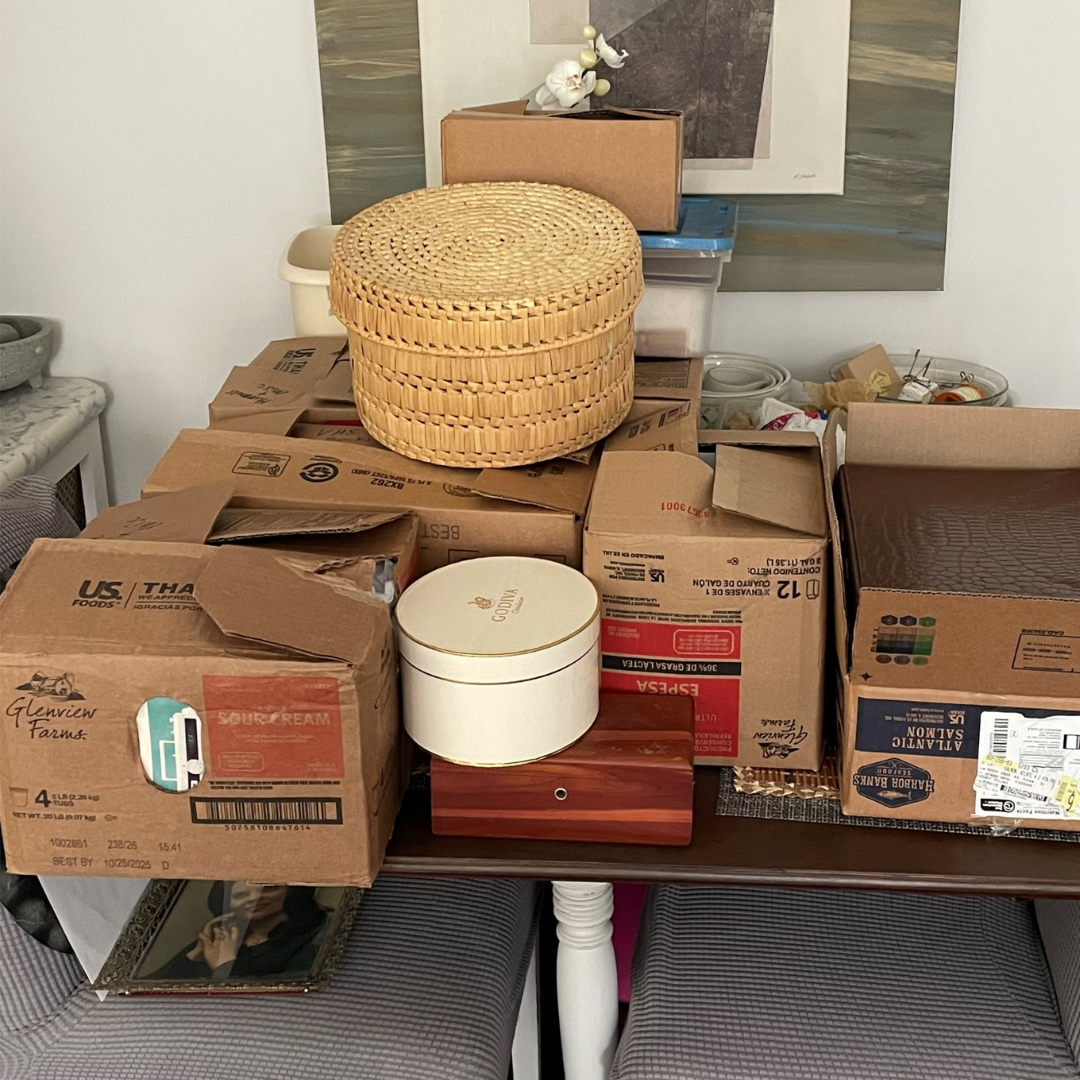
My parents recently moved into a one-bedroom senior apartment, and I just sold their longtime home.
They've been married for 56 years this week. Think about that for a minute. Fifty-six years of birthdays, holidays, furniture, family photos, wedding gifts, hand-me-downs, things from their parents, their grandparents, aunts, uncles, and probably people whose names I barely remember.
A lifetime of stuff…
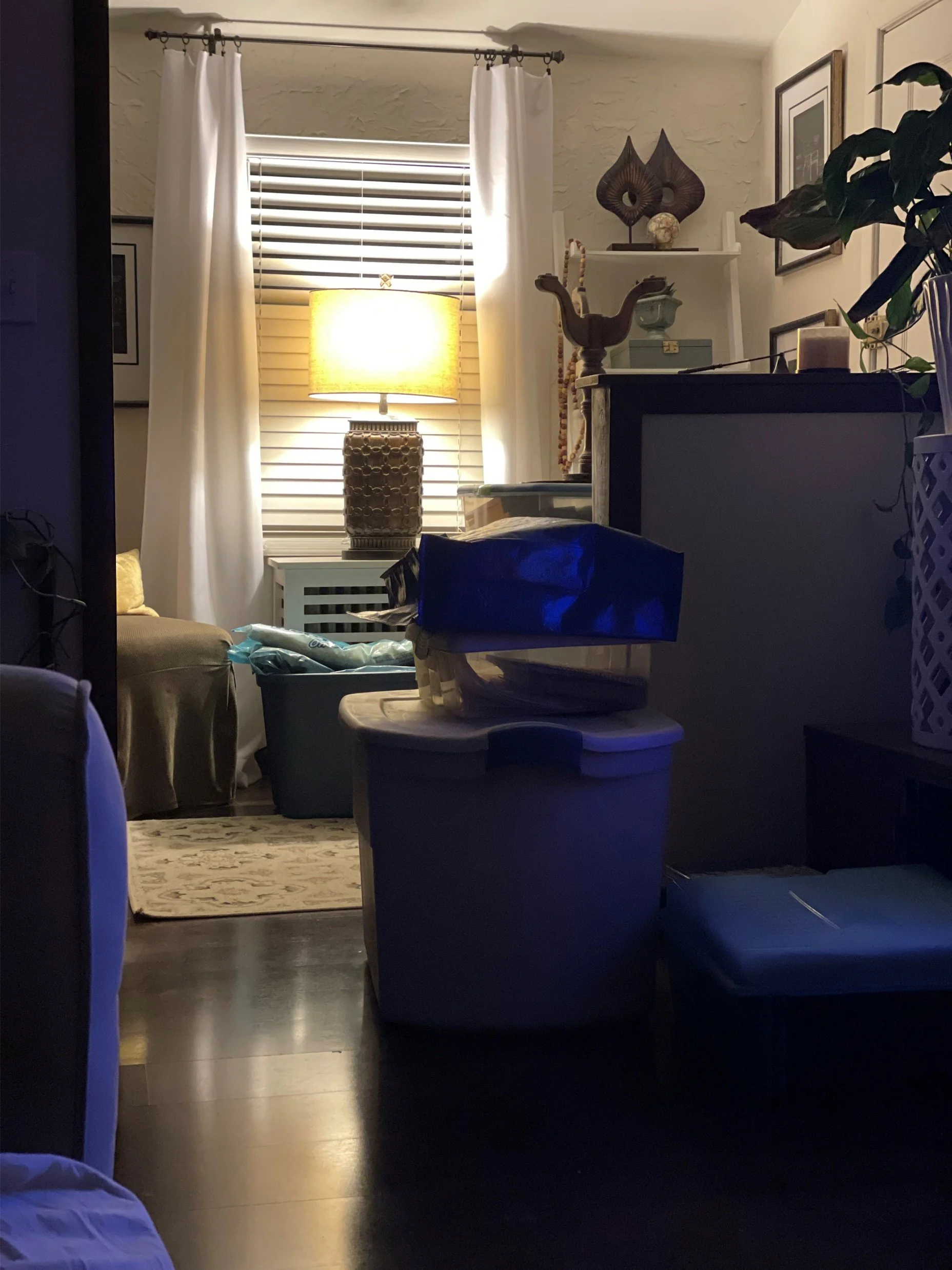
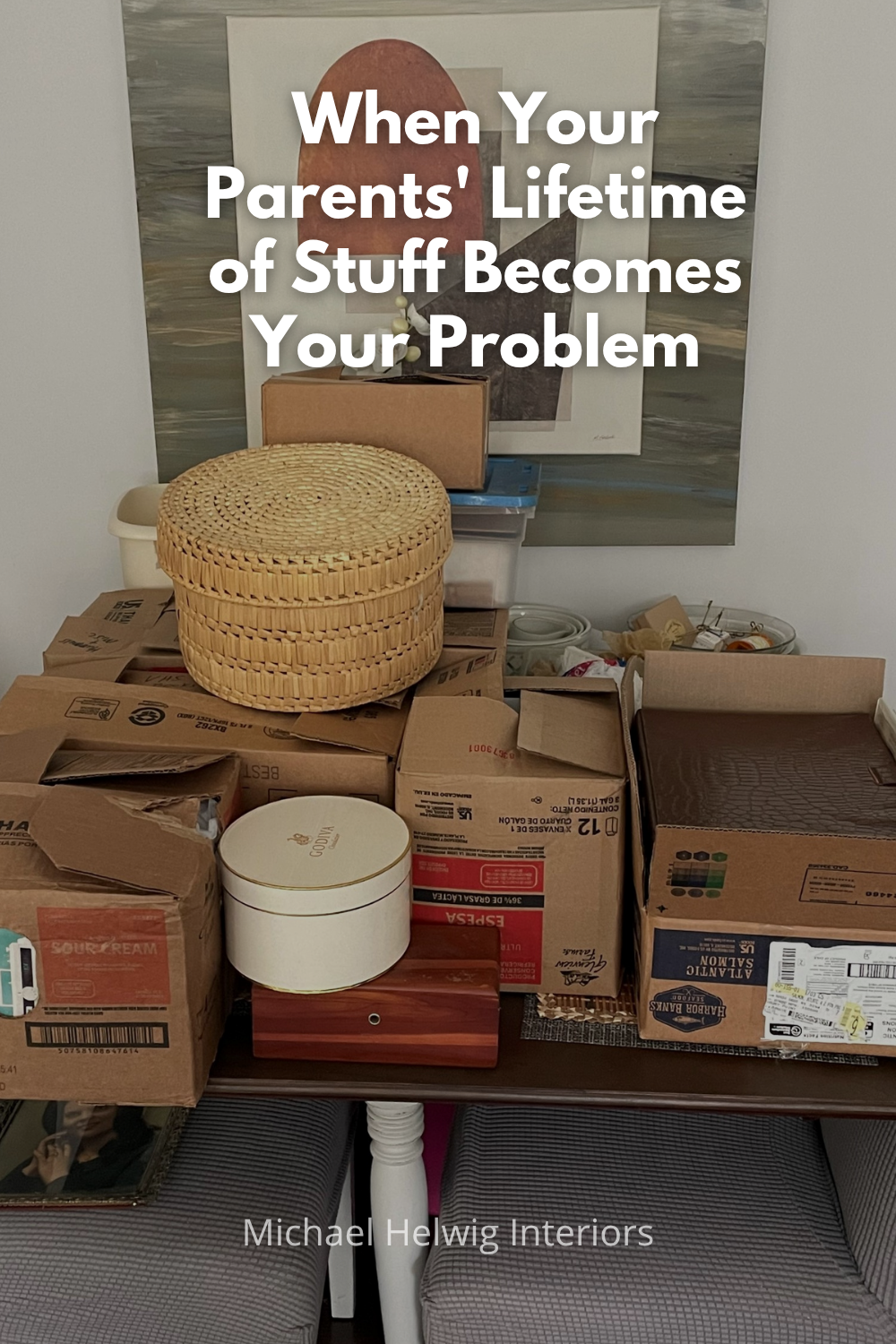
Over the past few weeks, I've been clearing out their house, and now all that stuff is in boxes. In every corner of my small house. Stacked wherever I could find a spot.
And I am overwhelmed.
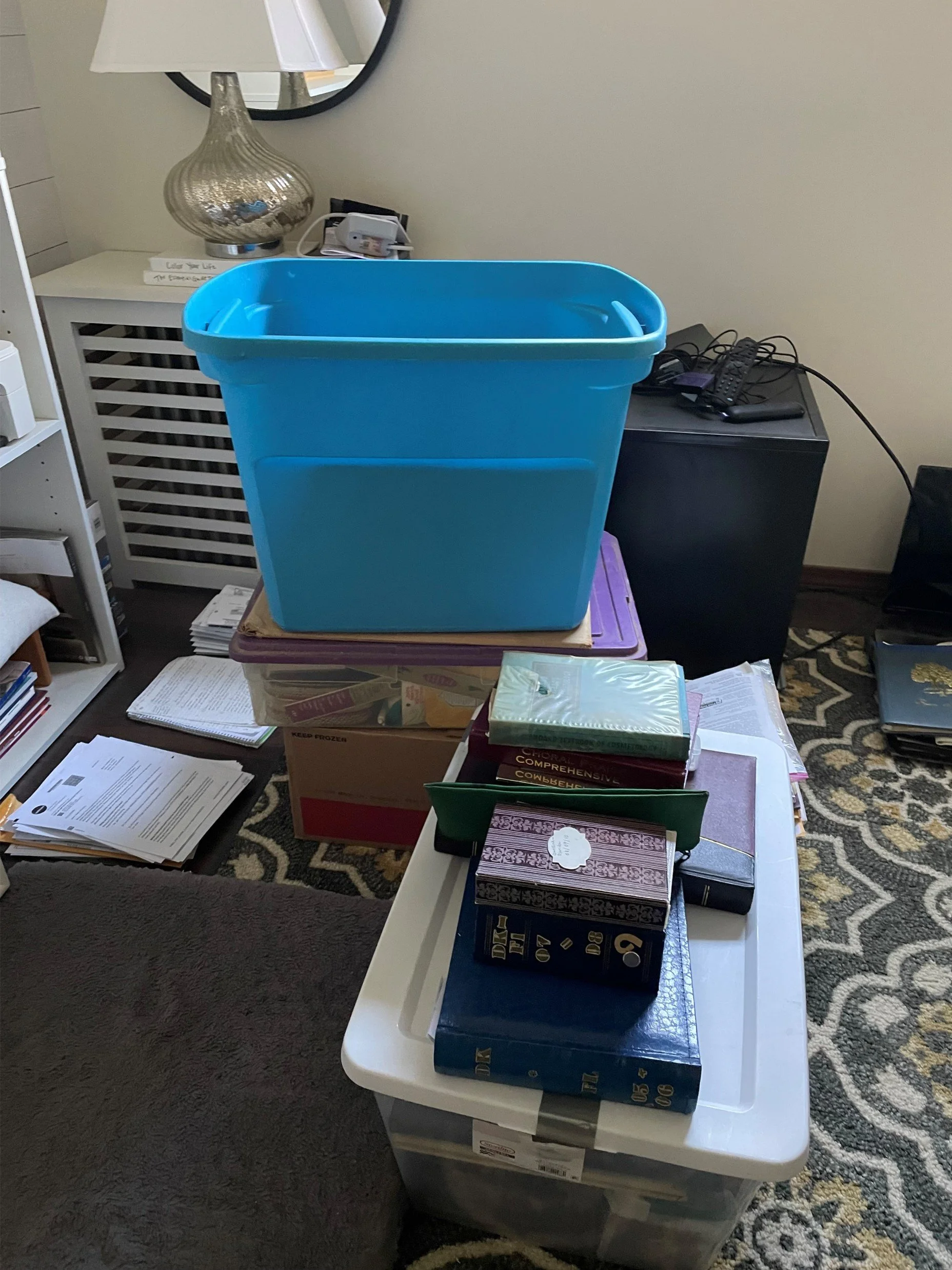
Here's the funny part. I'm a small-space interior designer. I've written a ton about decluttering, living with less, and making the most of the space you have. I know the rules. I know how to edit a room. I know how to decide what stays and what goes.
But when it's your own parents' stuff, it's a whole different ball game.
Because this isn't just stuff. It's history. It's memories. It's the things they bought together, the things they inherited, and the things they've held onto because someone they loved once owned them.
And now I'm the one who has to figure out what happens next. And that kind of sucks.
The Problem with Keeping Everything
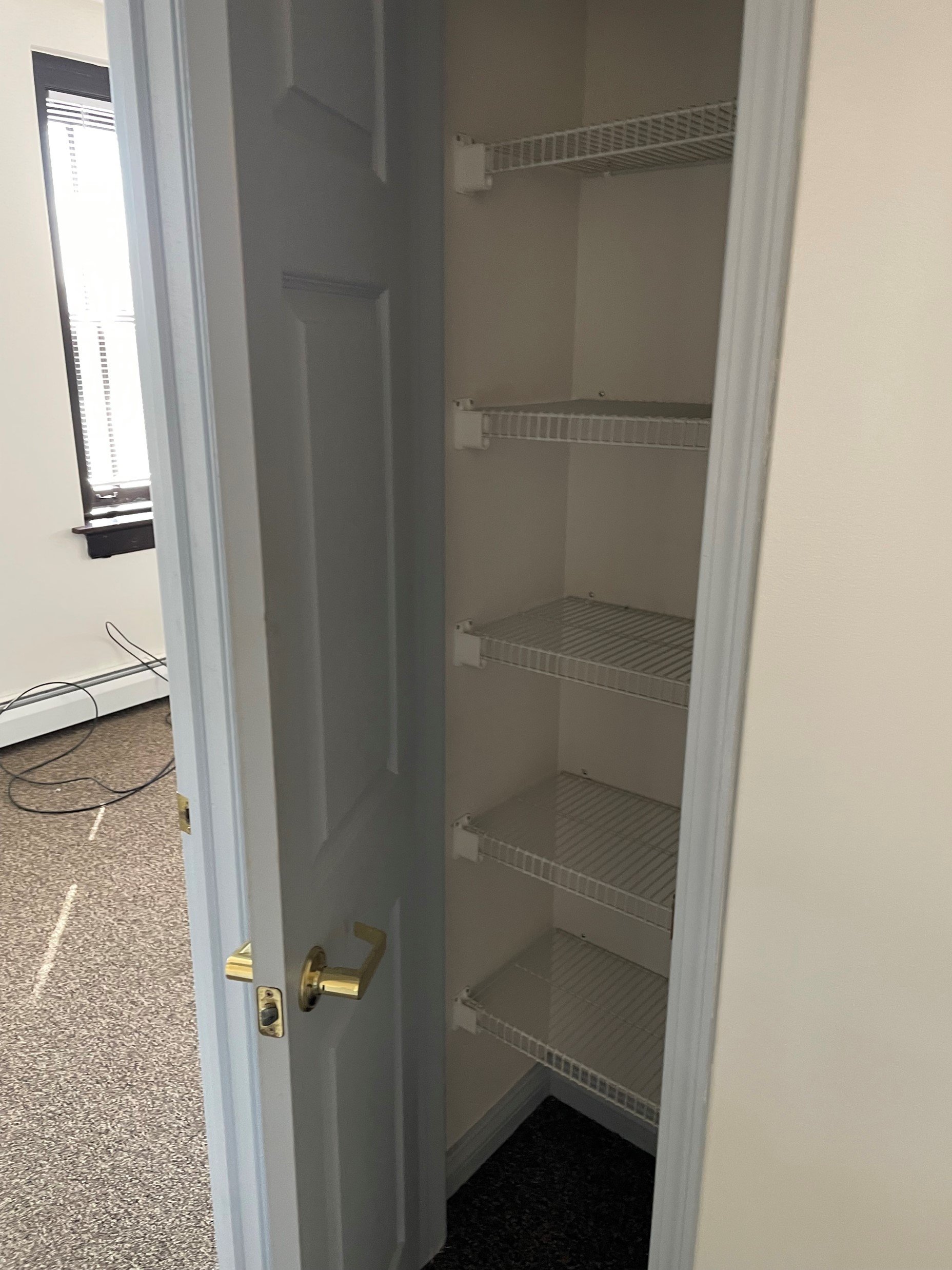
As I said, my parents moved into a teeny tiny one-bedroom apartment. A lovely new chapter, hopefully, but one with very limited storage. (One small linen closet, one double bedroom closet – already packed with clothes, and such.)
They simply could not take everything with them.
And I cannot keep everything for them.
I have my own home, my own life, and my own things. I don't have an empty basement or a spare house waiting to become the family museum. I have a small house, and right now, it feels like my parents' old house has moved right into it.
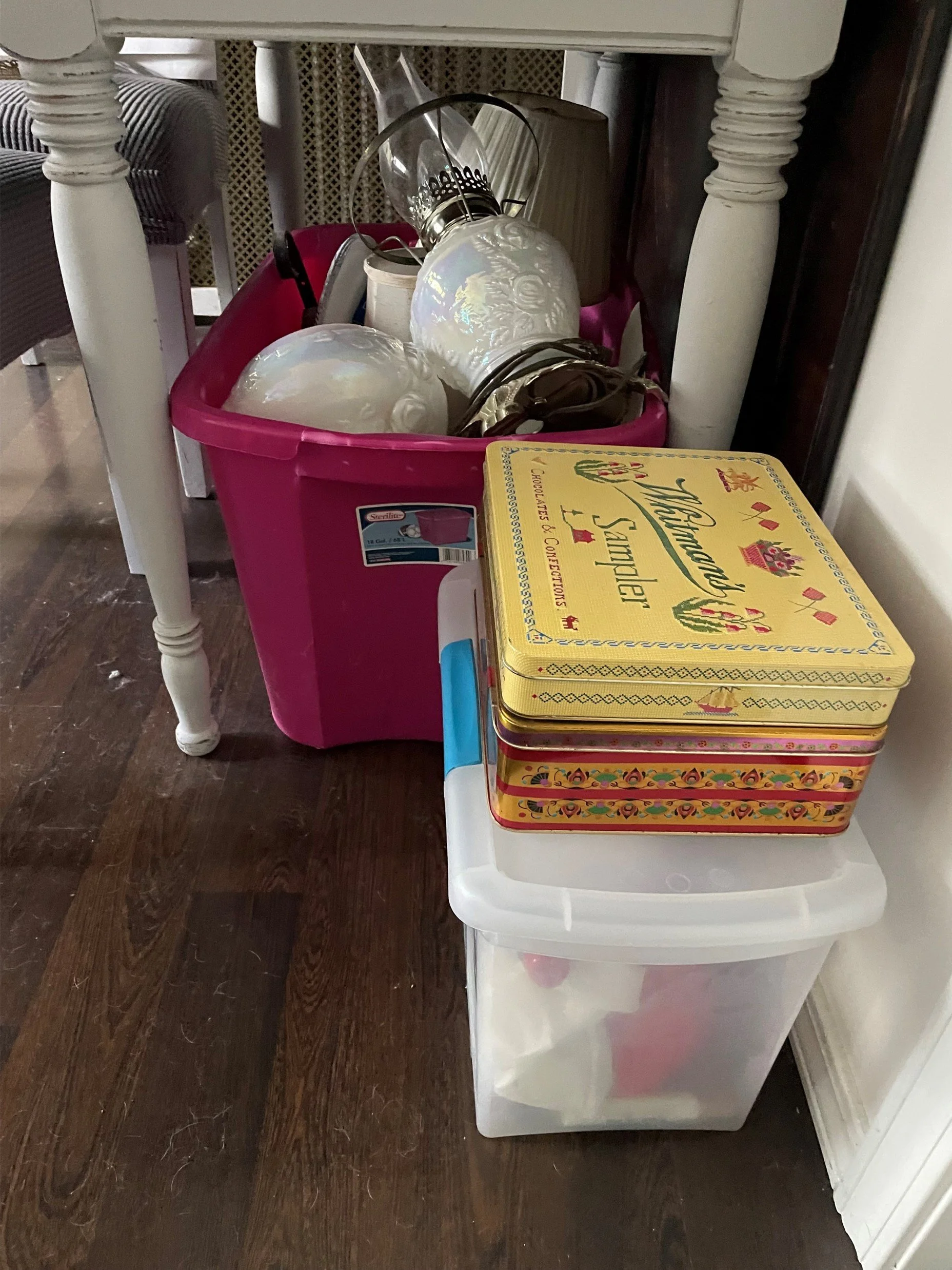
There are boxes of pictures. Furniture. Household items. Decorative things. Things that belonged to their parents and grandparents.
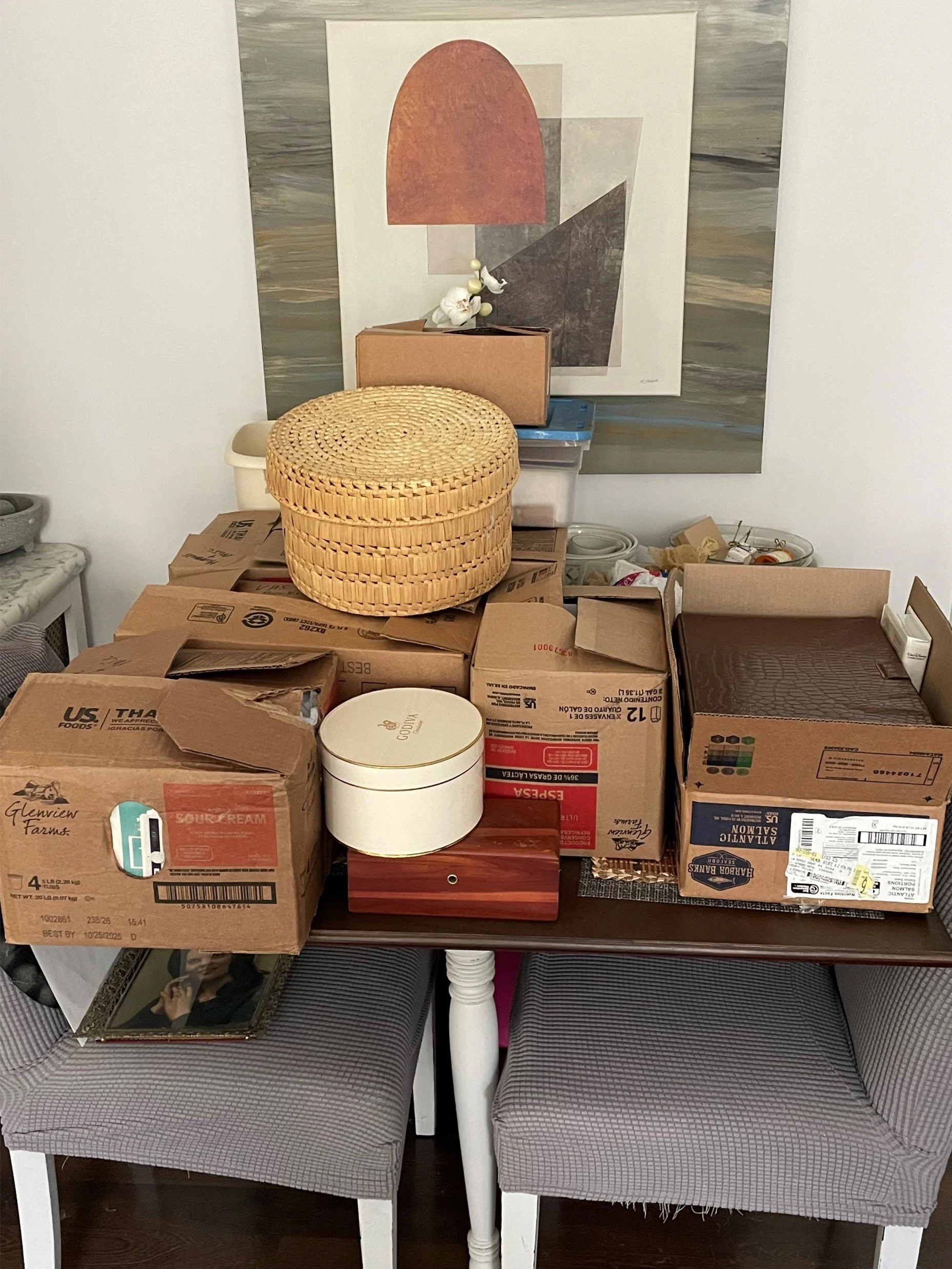
Some things are genuinely special. Others have been sitting in cupboards for decades, rarely used and probably not thought about until we had to decide what to do with them.
That's the thing about clearing out a home after so many years. You discover that not everything you've kept is necessarily something you still want. Sometimes you've just kept it because you've always kept it.
And when you've been married for 56 years, that's a lot of accumulated decisions.
Renting a Storage Unit Isn't Always the Answer
When you're faced with this much stuff, renting a storage unit seems like the easiest solution.
You don't have to make decisions right now. You can box everything up, move it into storage, and deal with it later.
Tempting? Absolutely.
But here's what I'm trying to remind myself: storage doesn't solve the problem. It postpones it.
It costs money every month to store things that may never be used again. A year goes by. Then another. The boxes stay closed, the furniture sits untouched, and you're paying to keep decisions you didn't want to make.
Of course, there are times when storage makes sense. Maybe there's a family member who wants a particular piece of furniture but doesn't have room for it yet. Maybe you need a little breathing room to sort through meaningful photographs or documents.
A short-term plan with a clear end date can be helpful.
But renting a unit just because you can't bear to decide what to do with everything? That's a different story.
I don't want to pay rent on my parents' past indefinitely. I want to make thoughtful decisions, deal with what I can, and move on. That’s not discounting their stuff, that’s saving my sanity, full stop.
My Parents Want to Keep It. I Don't Have Room for It.
This is probably the hardest part.
My parents want to keep as much as they can. And I understand why. These things represent their lives together. Some belonged to both my grandmothers. Others carry memories that I may not even know the stories behind.
How do you tell mom that the china cabinet she owned for decades won’t fit in their new apartment? How do you explain that the extra furniture, and the things they've inherited can’t all come along for the ride?
And how do you tell them that you can't take it all, either?
Because here's the reality: just because something is meaningful to my parents doesn't mean I have the space, the desire, or the obligation to keep it for the rest of my life.
That may sound harsh. Maybe it is a little harsh.
But I think I need to be honest about this.
I can love my parents and respect their memories without becoming the permanent keeper of everything they've ever owned.
I can listen to the stories. I can save some of the photographs. I can keep a few things that mean something to me, too.
But I cannot keep it all.
At some point, I have to draw a line. And that line has to be based on reality, not guilt.
So, What Do You Actually Do with a Lifetime of Stuff?
I'm trying to keep this simple. I don't need a complicated resale operation, weeks of online listings, or a second job managing other people's belongings. (Believe me, I’ve been agonizing over this for weeks!)
I need practical solutions that let me get things out of my house without throwing away things that could still be useful to someone else.
I’ve run this dilemma by some good friends and asked the internet too. Here's how I'm thinking about it now:
1. Keep the things that genuinely matter.
Not everything that’s been in the family for generations needs to stay in the family for another generation. I don’t have kids, and I’m the end of the line, so I’ve become very stoic about my own stuff, and I will apply that stoicism to their stuff too.
I'm trying to distinguish between things that have real meaning to me and things I feel obligated to keep because of their history.
A few favorite photographs. A meaningful keepsake. Something that reminds me of my parents or grandparents in a way that matters to me.
Those things deserve consideration.
But I don't need every serving dish, every framed picture, every knickknack, or every piece of furniture to prove that I remember where I came from.
Memories are not stored in objects.
2. Give family members a chance to claim things but set a deadline.
If you have siblings, cousins, or other relatives who might want something, let them know what's available.
But be specific. Send pictures. Ask them to identify what they want. Give them a date to collect it.
I'm learning that "I might want that someday" isn't the same as actually wanting it enough to make room for it.
If someone wants something, that's great. But I can't become a long-term storage facility for every family member who isn't quite ready to decide.
3. Donate the useful things.
I’m planning to donate useful household stuff, linens, kitchenware, clothing, and furniture may be useful to someone else.
Local charities, thrift stores, community organizations, and furniture banks may accept some of these things. Their needs and pickup policies vary, so a quick phone call before loading my car is the idea.
Some organizations even offer furniture pickup, which can be a huge help when you're dealing with bulky stuff.
I like the idea that something my parents used and enjoyed for years might help another family furnish a home or get started in a new apartment.
That feels better than keeping it in a box in my house just because I don't know what else to do with it.
4. Sell a few things, but don't turn this into a business.
There may be furniture, antiques, collectibles, or household items worth selling.
But I'm trying to be realistic about the time involved.
Photographing everything, researching prices, answering messages, negotiating with strangers, and arranging pickups can become a project that drags on for months.
For anything that seems genuinely valuable, I'll consider an appropriate appraisal or a reputable local reseller. For ordinary furniture and household goods, a quick local sale at a reasonable price may be enough.
And for the things that aren't worth the time and effort? Donation may be the better choice.
The goal isn't to squeeze every possible dollar out of every object. The goal is to clear the house, make reasonable decisions, and get my own home back.
5. Take photographs of things you can't keep.
This one is important, especially with stuff that’s been passed down through generations.
Sometimes the story matters more than the object.
For example, maybe take a picture of the old dining table where everyone ate for the holidays. Snap a picture of the collection of figurines, the family heirloom that nobody has room for, or the piece of furniture that’s been in the family forever.
If you know the story behind something, write it down. Who owned it? Where did it come from? Why was it special?
Keep the story, not every physical object.
And perhaps a photograph will be enough. Perhaps it won't. But it's an option worth considering before deciding that everything must be kept.
When Is It Time to Be Brutal?
I'm not sure I love the word brutal, but I understand the feeling behind it.
There comes a point when I have to stop negotiating the fate of every object.
I have to stop asking whether I might need it, whether someone might want it, whether it could come in handy, or whether you'll regret letting it go.
Instead, you ask a few more useful questions.
Do I love it? Do I use it? Do I have a place for it? Would I choose to bring this into my home today?
And if the answer is no, why am I keeping it?
The fact that something belonged to my grandmother doesn't automatically mean I need to own it. The fact that my parents have kept something for 35 years doesn't mean I have to keep it for another 35.
I can respect the past without making it the responsibility of my future.
That's a lesson I talk about when helping clients with small spaces. Every object takes up room, and room is a limited resource.
But I'm discovering that this isn't just about physical space. It's also about emotional space. It's about having the freedom to live in my own home without feeling buried under decisions that belong to someone else's life.
And sometimes, making room means letting go of things that have been around for longer than you have.
The Part Nobody Really Talks About
Clearing out your parents' home is emotional, even when everyone is doing well and the move is a positive one. I’ve had my share of very weepy days as of late.
You're looking at the physical evidence of decades together. You're seeing things they bought when they were young, things they used when raising me, and things they held onto because they thought I might want them someday.
I realized that you're not just clearing cupboards. I’m closing a chapter.
Maybe that's why it's so difficult to be decisive. Letting go of this stuff feels like letting go of a memory, even when I know perfectly well that the memory isn't going anywhere.
I'm trying to remind myself that my parents' life together isn't contained in these boxes. Fifty-six years together cannot be reduced to furniture, pictures, and household stuff.
Their life is in the stories they tell, our little family, and the memories we share.
I don't need to keep every object to honor that.
I’m cutting myself slack and if you’re doing this, you should too.
Making Room for What's Next
Right now, my house is full of boxes. I'm still figuring out what to keep, what to donate, what to sell, and what needs to leave.
I haven't solved it all. I'm not going to pretend I have.
But I know that I can’t keep everything, and I don't want to spend the next year working my way through a storage unit full of things I was afraid to let go of.
My parents deserve to enjoy their new home without being surrounded by things that no longer fit their lives. And I deserve to enjoy my own home without being overwhelmed by the leftovers of theirs.
There has to be a middle ground between throwing everything away and keeping everything forever.
That's what I'm trying to find.
So, if you're facing the same situation, here's my advice — from someone who knows a thing or two about decluttering but is learning all over again that it's different when it's personal.
Keep what matters to you. Give others a fair chance to get what matters to them. Donate what can be useful. Sell the things worth the effort. Keep the stories and photographs that mean something.
And then let the rest go.
You are allowed to have your own home, your own space, and your own future.
You don't have to carry your entire family's lifetime of stuff into it.
Read Next:

New Year Small Space Reset: 7 Ways to Declutter Your Awkward Rooms for 2026
Traditional decluttering fails in awkward rooms. Here are 7 layout-based strategies for spaces with off-center windows, weird corners, and multiple doorways.
Michael is Principal designer and blogger at Michael Helwig Interiors in beautiful Buffalo, New York. Since 2011, he’s a space planning expert, offering online interior e-design services for folks living in small homes, or for those with awkward and tricky layouts. He’s a frequent expert contributor to many National media publications and news outlets on topics related to decorating, interior design, diy projects, and more. Michael happily shares his experience to help folks avoid expensive mistakes and decorating disappointments. You can follow him on Pinterest, Instagram and Facebook @interiorsmh.